


How To Optimize Your Website for Google AI Mode
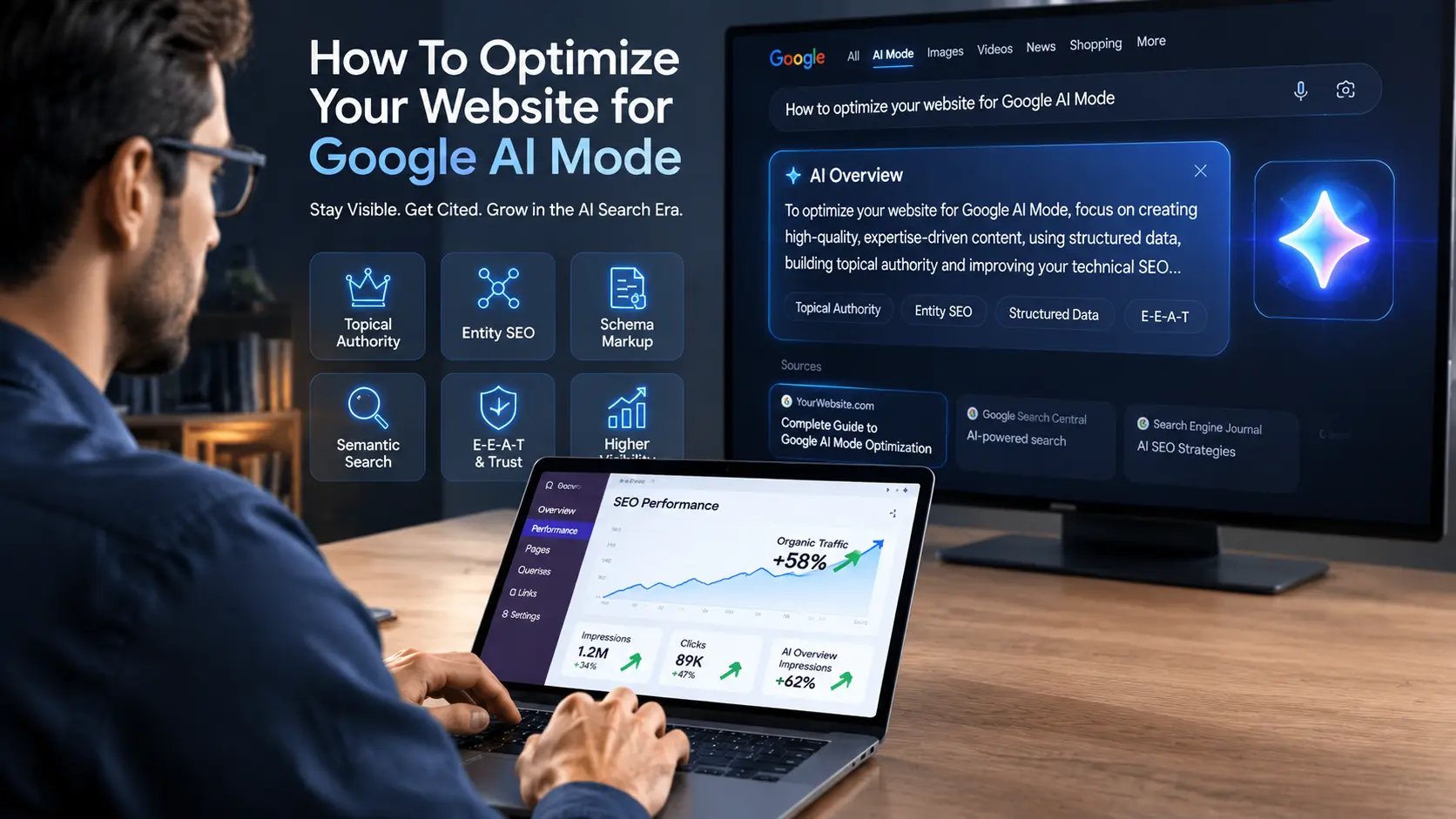
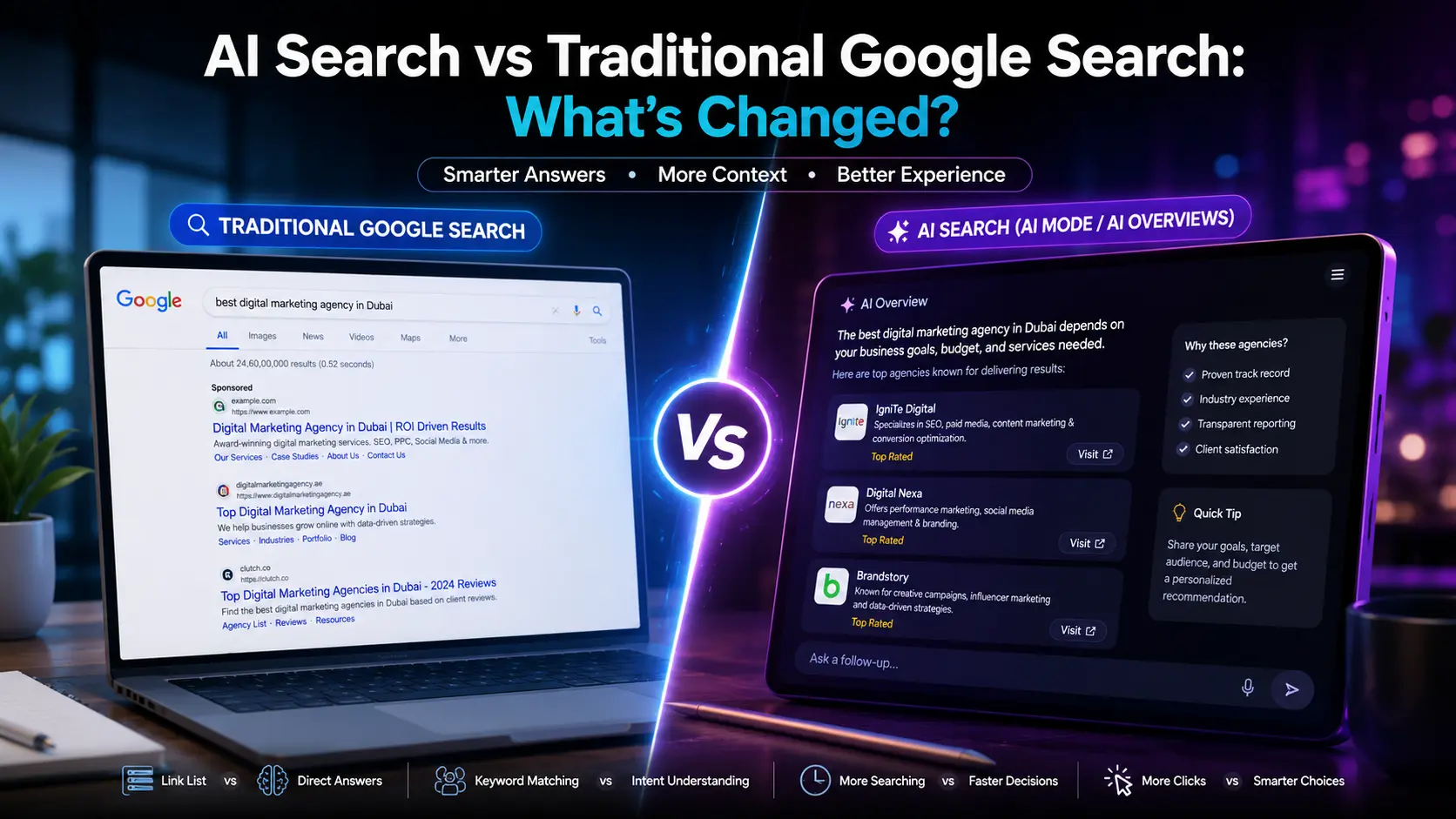
Google Search is no longer just about blue links. With Google AI Mode, users receive conversational answers, follow-up suggestions, and AI-generated summaries before they even click on a website. This shift has changed how websites earn visibility.
If your website is still optimized only for traditional SEO, you’re already behind. In 2026, businesses need to optimize for AI search, semantic understanding, and entity-based SEO to appear in Google’s AI-generated responses.
Table of Contents
What Is Google AI Mode?
Google AI Mode is Google’s AI-powered search experience that combines traditional search with large language models. Instead of displaying only a list of webpages, Google analyzes multiple trusted sources and generates detailed answers directly within search results.
Unlike traditional SEO, AI Mode evaluates:
- Content quality
- Entity relationships
- Author expertise
- Website authority
- Topical depth
- User intent
- Structured data
Google’s AI attempts to understand topics the same way humans do rather than relying only on keywords.
Why Google AI Mode Matters
Google processes billions of searches every day, and AI-powered search experiences continue to expand across countries and industries. According to Google, AI-powered features encourage users to ask longer, more detailed questions, creating new opportunities for websites that provide comprehensive answers.
Instead of competing for Position #1 alone, websites now compete to become sources that Google’s AI trusts enough to cite.
That means visibility depends on credibility, expertise, and semantic relevance, not just backlinks.
1. Build Topical Authority Instead of Publishing Random Blogs
One high-ranking article is no longer enough.
Google AI prefers websites that demonstrate complete expertise on a subject.
For example, instead of writing only:
Create an entire knowledge hub:
- AI SEO Guide
- Technical SEO
- Entity SEO
- Local SEO
- Programmatic SEO
- E-commerce SEO
- Schema Markup
- Core Web Vitals
- AI Search Optimization
- Semantic Search
- Google AI Mode
Every article should connect naturally through internal links.
When Google sees hundreds of interconnected pages covering one topic, it recognizes your website as an authority.
2. Optimize for Entities, Not Just Keywords
Google understands people, places, organizations, products, and concepts as entities.
Instead of repeating a keyword twenty times, strengthen the relationships between related entities.
For example, if your topic is Google AI Mode, naturally include concepts such as:
- Search Generative Experience
- AI Overviews
- Structured Data
- Large Language Models
- Knowledge Graph
- Semantic Search
- Schema Markup
- Natural Language Processing
- E-E-A-T
- Search Intent
This helps Google’s AI understand the broader context of your content.
3. Answer Questions Like Real Users Ask Them
AI Mode is designed around conversations.
Instead of targeting only:
Google AI Mode
Answer complete questions such as:
- How does Google AI Mode work?
- How do I optimize my website for Google AI?
- Does schema help AI search?
- Can AI Overviews improve website traffic?
- What content ranks in Google AI Mode?
Use these questions as headings throughout your article.
This increases your chances of appearing in AI-generated answers.
4. Create Content That Solves Complete Problems
Many websites still write 500-word articles filled with keywords.
Google AI prefers comprehensive resources.
Instead of explaining only what something is, also explain:
- Why it matters
- How it works
- Common mistakes
- Best practices
- Real examples
- Step-by-step implementation
- Expected outcomes
The goal is to eliminate the need for users to visit multiple websites.
5. Use Schema Markup Everywhere
Structured data helps Google understand your content more accurately.
Important schema types include:
- Article
- FAQ
- Organization
- LocalBusiness
- Product
- Service
- Breadcrumb
- Person
- Review
- VideoObject
Schema does not directly improve rankings, but it improves Google’s understanding of your content, making it easier for AI systems to interpret and surface relevant information.
6. Improve Internal Linking
Google AI follows topic relationships.
Instead of linking randomly, build logical content clusters.
Example:
Homepage
↓
SEO Services
↓
AI SEO
↓
Entity SEO
↓
Schema Guide
↓
Google AI Mode
↓
AI Overview Optimization
This structure distributes authority across your website while helping search engines understand the relationship between topics.
7. Demonstrate Real Experience
Google increasingly values original experience over generic AI-generated text.
Strengthen your content with:
- Case studies
- Original screenshots
- Analytics data
- Client success stories
- Before-and-after results
- Expert opinions
For example:
“After implementing entity-based content clusters and schema markup, our client increased AI Overview impressions by 58% within four months.”
Real-world examples add credibility that AI-generated content alone cannot provide.
8. Optimize Technical SEO
Even excellent content struggles if your website has technical issues.
Focus on:
- Fast page speed
- Mobile responsiveness
- HTTPS security
- Crawlable pages
- Clean URL structure
- XML sitemap
- Optimized robots.txt
- Core Web Vitals
- Canonical tags
A technically sound website allows Google’s crawlers and AI systems to access and understand your content efficiently.
9. Build Brand Authority Across the Web
Google AI doesn’t evaluate only your website.
It also looks for consistent information across trusted sources.
Strengthen your digital presence by:
- Publishing guest articles
- Earning high-quality backlinks
- Maintaining accurate business profiles
- Being mentioned in industry publications
- Keeping your brand information consistent across platforms
The stronger your online reputation, the more confidence Google’s AI has in citing your content.
10. Continuously Refresh Your Content
AI search favors current and relevant information.
Review your important pages regularly to:
- Update statistics
- Replace outdated screenshots
- Add new FAQs
- Improve examples
- Expand sections based on new search trends
Fresh content signals ongoing expertise and helps maintain visibility in evolving AI-powered search results.
A Practical Framework for Google AI Mode Optimization
Follow this framework to improve your website’s chances of appearing in AI-generated search results:
- Identify your core topic and build supporting content around it.
- Optimize pages for entities and semantic relevance, not just exact-match keywords.
- Use descriptive headings that answer real user questions.
- Add structured data to help Google understand your content.
- Strengthen internal linking between related pages.
- Publish original insights, research, or case studies.
- Improve technical SEO and Core Web Vitals.
- Earn authoritative backlinks and brand mentions.
- Refresh high-value content regularly based on new developments.
- Track impressions, clicks, and AI-related visibility in Google Search Console to refine your strategy.
Conclusion
Google AI Mode is changing how people discover information online. Success is no longer determined by keyword density or backlink volume alone. Websites that provide trustworthy information, demonstrate expertise, organize content around topical authority, and optimize for entities and user intent are more likely to become trusted sources for AI-generated answers.
Businesses that start adapting today will be in a much stronger position as AI-driven search continues to evolve. By focusing on quality, semantic relevance, technical excellence, and genuine expertise, you can improve your chances of earning visibility in both traditional search results and Google’s AI-powered experiences.
Frequently Asked Questions?
How to optimize a website for Google AI?
Create high-quality, helpful content, implement structured data, improve page speed, ensure mobile-friendliness, and demonstrate E-E-A-T (Experience, Expertise, Authoritativeness, and Trustworthiness).
How to optimize content for AI Mode?
Write clear, well-structured, and fact-based content that directly answers user questions. Use headings, FAQs, schema markup, and keep information accurate and up to date.
How to optimize your website for AI agents?
Make your website easy to crawl and understand by using clean site architecture, structured data, fast loading pages, accessible content, and clear internal linking.
Is schema markup necessary for AI search?
Schema markup is highly recommended because it helps Google understand your content more accurately, improving your chances of appearing in AI-powered search features.
How long does it take to see results from Google AI Mode optimization?
The timeline varies depending on your website’s authority, competition, and content quality. Most websites begin seeing improvements in organic visibility within three to six months of consistently implementing modern SEO best practices.