



Why Your Digital Marketing Isn't Generating Qualified Leads
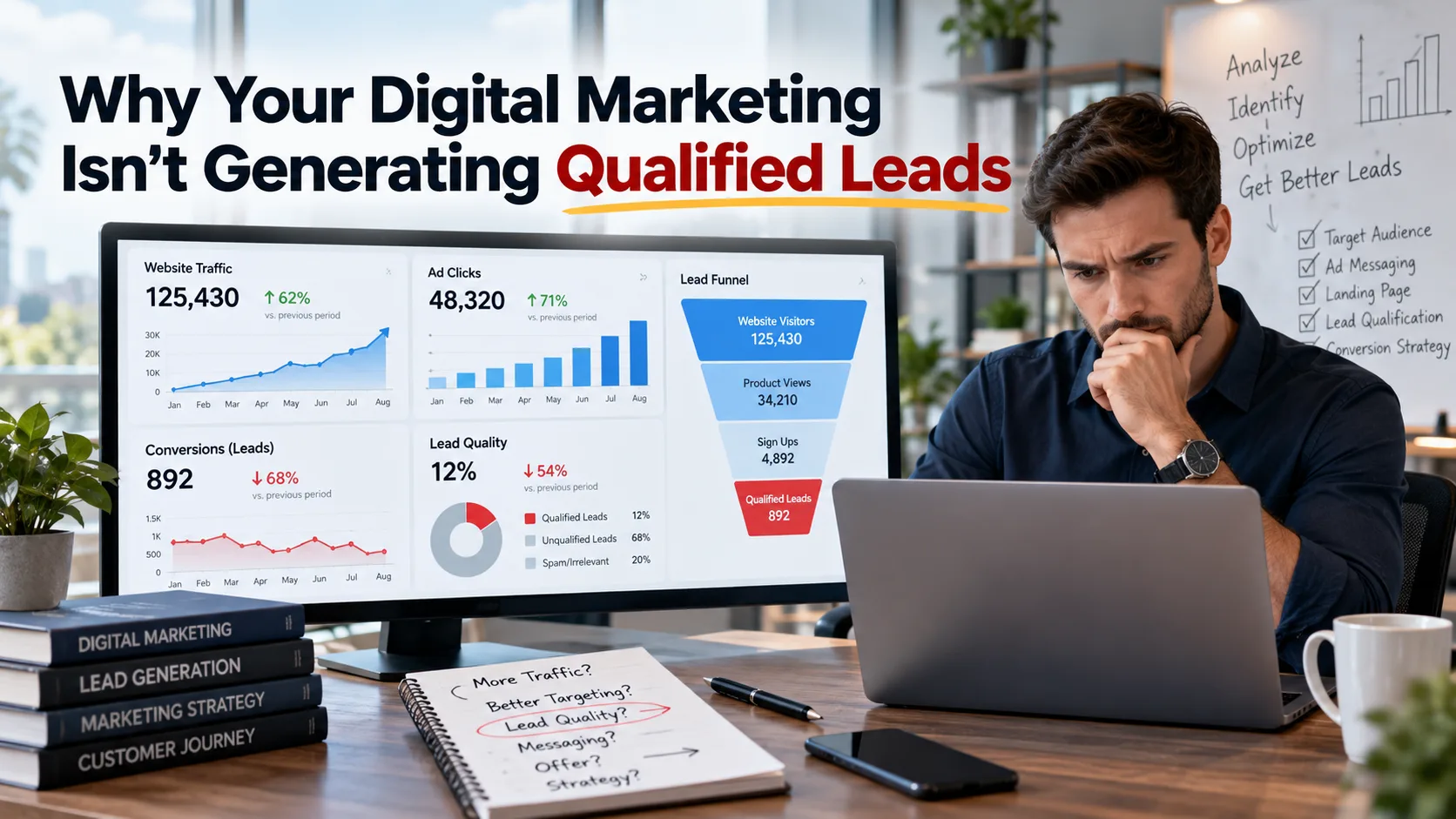
You’re running Google Ads. Your website gets visitors. Your social media posts receive engagement. But when you check your enquiries, something doesn’t add up.
People ask for prices and disappear. Some enquiries are completely irrelevant. Others aren’t ready to buy.
Meanwhile, your marketing budget keeps shrinking.
For businesses in Dubai and across the UAE, this can be frustrating, especially when you’re investing in multiple digital marketing channels.
The problem isn’t always a lack of leads. It’s attracting the wrong people, delivering the wrong message, or losing potential customers before they convert.
You’re Attracting Traffic, Not Potential Customers
Getting more website visitors sounds like progress. But traffic alone doesn’t pay your bills.
Imagine you run an interior design company in Dubai.
Your website ranks for “modern bedroom ideas” and attracts hundreds of visitors. However, most are looking for inspiration, not professional interior design services.
Now compare that with someone searching for “villa interior design company in Dubai.”
The second search suggests a much stronger intention to hire.
What should you do?
Focus on keywords that match what your customers actually need.
| Low commercial intent | Higher commercial intent |
| What is SEO? | SEO services for businesses in Dubai |
| Website design ideas | Website development company in Dubai |
| Social media tips | Social media marketing services Dubai |
| Interior design trends | Villa interior design services Dubai |
Not every informational keyword is useless. Educational content can help potential customers discover your business. But your marketing strategy needs a clear path from discovery to enquiry.
Your Google Ads Are Reaching the Wrong Audience
Google Ads can bring relevant enquiries, but only when campaigns are aligned with customer intent.
One common mistake is targeting broad keywords without reviewing what people actually search before clicking an ad.
For example, a company selling custom business software might advertise for “software development.”
That search could come from students, job seekers, or businesses researching software development costs.
How to improve lead quality
- Review your Google Ads search terms report regularly.
- Add relevant negative keywords, such as “jobs” or “course,” where appropriate.
- Separate campaigns by service and customer intent.
- Use location targeting that matches your service area.
- Track qualified enquiries instead of counting every form submission as a successful conversion.
Also, review whether your campaigns are optimized for genuine business enquiries rather than low-value actions.
A campaign generating 50 enquiries isn’t necessarily better than one generating 15 if most of those 50 are irrelevant.
Your Website Doesn’t Give Visitors a Reason to Enquire
Your ad might be working perfectly. Someone clicks because they’re interested in your service.
Then they reach your website.
The headline is vague. The services aren’t explained clearly. There are no relevant examples, and the contact form asks for too much information.
They leave.
This is where many businesses lose potential customers.
What a lead-generating website needs
Your landing page should answer five questions quickly:
- What service do you provide?
- Who is the service for?
- How can you help solve the visitor’s problem?
- Why should someone consider your business?
- What should they do next?
For example, instead of a generic headline like “We Provide Innovative Digital Solutions,” try something specific:
“Getting Website Traffic but No Enquiries? Find Out What’s Stopping Your Visitors From Contacting You.”
Support the message with relevant service details, genuine proof, and a clear CTA.
A better website experience doesn’t guarantee enquiries, but it removes unnecessary barriers.
You’re Measuring Leads, Not Lead Quality
This is one of the biggest gaps in digital marketing reporting.
A business receives 100 enquiries and celebrates a successful campaign. But the sales team discovers that only 12 match its target customers.
The remaining enquiries include people with unrealistic budgets, unrelated requests, or no immediate buying plans.
Your campaign might look successful in Google Ads or GA4 while delivering little business value.
Track the metrics that matter
Use this simple example to understand the difference:
| Metric | Campaign A | Campaign B |
| Marketing spend | AED 5,000 | AED 5,000 |
| Total enquiries | 100 | 40 |
| Qualified leads | 10 | 20 |
| Cost per qualified lead | AED 500 | AED 250 |
Illustrative example, not actual Sagar Tech campaign results.
Campaign B generates fewer enquiries but twice as many qualified leads at half the cost per qualified lead.
The lesson: Stop judging marketing performance only by cost per lead. Measure how many enquiries become genuine sales opportunities.
Your Marketing and Sales Teams Aren’t Connected
Even a qualified lead can be lost when nobody follows up properly.
Someone requests a quotation on Monday. Your team responds on Wednesday. By then, the customer may already be speaking with another company.
Create a simple lead-handling process:
- Assign every enquiry to a responsible team member.
- Record the customer’s service requirement, budget, and timeline.
- Set follow-up reminders.
- Track which enquiries become paying customers.
Your customer relationship management (CRM) system should connect marketing activity with sales outcomes.
Google recommends enhanced conversions for leads to improve offline conversion measurement. Its research found a median 10% increase in measured conversions among advertisers using first-party customer data alongside click identifiers, compared with standard offline imports. This is a measurement improvement, not a guaranteed increase in sales.
You Haven’t Defined What a Qualified Lead Looks Like
Before spending more money, define your ideal customer.
For a B2B company in Dubai, qualification criteria might include location, industry, project budget, decision-making authority, and expected purchase timeline.
A practical framework is BANT:
- Budget: Can the prospect afford the service?
- Authority: Can they approve the purchase?
- Need: Does your solution address their problem?
- Timeline: When are they planning to proceed?
Not every prospect must satisfy all four immediately. Use the answers to prioritize follow-ups, not automatically reject potential customers.
A 30-Day Plan to Improve Lead Quality
Week 1: Audit your leads
Review enquiries from the previous 30–90 days. Identify irrelevant keywords, poor-quality sources, and lost opportunities.
Week 2: Fix targeting
Refine Google Ads keywords, negative keywords, location settings, and audience messaging.
Week 3: Improve conversions
Test landing page headlines, enquiry forms, mobile usability, and CTAs.
Week 4: Measure results
Compare qualified lead rates, cost per qualified lead, and sales outcomes against your baseline.
Stop Paying for Leads That Never Become Customers
If your digital marketing generates clicks but few genuine sales opportunities, increasing your budget may only make the problem more expensive.
Start by understanding who your campaigns attract, what happens after they click, and why enquiries fail to become customers.
At Sagar Tech, we believe marketing decisions should begin with understanding the business problem, not simply chasing higher traffic numbers.