


AI Search vs Traditional Google Search: What’s Changed?
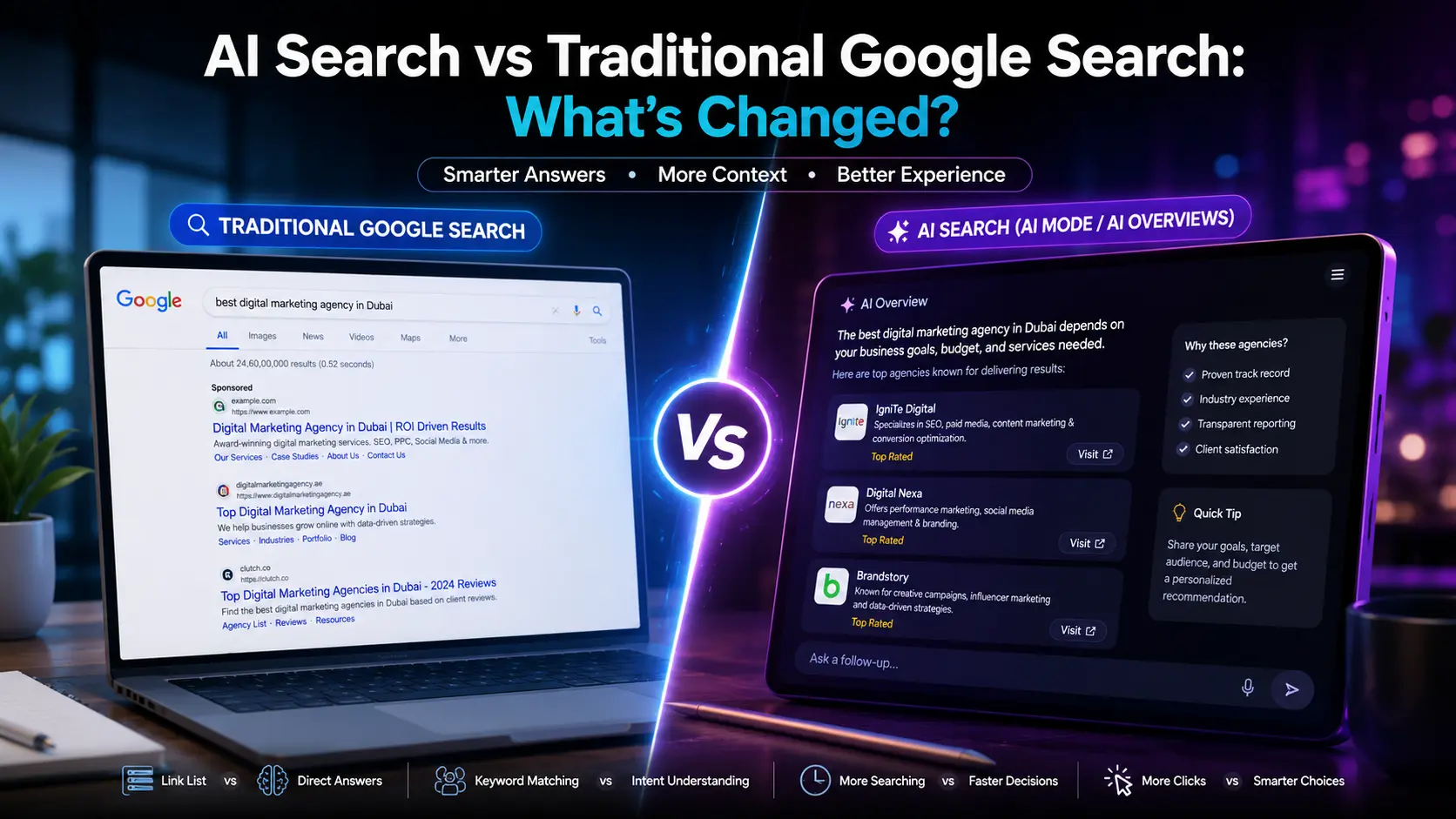
Google Search is no longer just a list of blue links. In current time search is becoming more conversational, contextual, and answer-focused. With AI Overviews and AI Mode, Google can understand complex questions, combine information from multiple sources, and provide a direct response before users visit a website.
This shift doesn’t mean traditional SEO is dead. It means businesses need to understand how AI search differs from traditional Google Search and adapt their SEO strategy accordingly.
Table of Contents
What Is Traditional Google Search?
Traditional Google Search works by understanding a query and ranking relevant webpages in the search engine results pages (SERPs). Google evaluates hundreds of signals, including relevance, content quality, links, usability, location, freshness, and search intent.
For example, someone searching “best SEO agency in Dubai” would traditionally see paid ads, local results, organic listings, directories, and other SERP features. The user then chooses a result, visits the website, and finds the information they need.
Ranking highly therefore meant winning visibility and, potentially, the click.
That basic model still exists, but AI has added another layer between the query and the website.
What Is AI Search?
AI search focuses on answering the user’s question rather than simply identifying webpages that may contain the answer.
Google’s AI Mode allows people to ask longer and more complicated questions, continue with follow-up questions, and even search using images. Google reported in 2026 that AI Mode had surpassed one billion monthly active users globally.
Consider the difference between these searches:
Traditional search: “SEO agency Dubai”
AI-style search: “Which type of SEO agency in Dubai would be best for a small ecommerce business that wants to increase organic sales without depending heavily on paid ads?”
The second query contains significantly more context. Google can interpret the requirements, break the question into different parts, retrieve supporting information, and generate a useful response.
This is why SEO is moving from simply ranking for keywords to becoming a trusted source that search engines can understand and cite.
AI Search vs Traditional Search: The Biggest Difference
Traditional search is largely based around retrieval and ranking. AI search adds synthesis and reasoning.
Instead of making users open five different webpages to compare information, an AI-generated result can bring relevant information together and provide a summarized answer with supporting links.
User behaviour is changing as a result.
A Pew Research Center analysis found that users clicked a traditional search result in 8% of visits when an AI summary appeared, compared with 15% when an AI summary was not present. Links directly inside the AI summaries received clicks in only 1% of visits in the study.
By 2026, Pew also found that 60% of U.S. adults said they read AI summaries appearing at the top of search results.
For businesses, this means ranking alone is no longer the complete SEO objective. Visibility inside the answer itself is becoming increasingly valuable.
Keywords Are Becoming Topics and Entities
Traditional SEO often started with a primary keyword and related secondary keywords. Keywords still matter, but modern search engines are increasingly interested in relationships between topics, entities, attributes, and user intent.
Imagine a Dubai-based digital marketing agency publishing only one page targeting “SEO services Dubai.”
That page may be relevant, but it provides Google with limited evidence of expertise.
A stronger topical structure could cover technical SEO, local SEO, ecommerce SEO, Google Business Profile optimization, AI search optimization, website migrations, SEO audits, link acquisition, and industry-specific SEO challenges.
These connected pages help establish topical authority while giving search systems more context about what the business actually knows.
Entity SEO strengthens this further. Clearly defining your company, services, specialists, locations, clients, experience, and relationships with recognised topics helps search engines understand who you are and what your business is relevant for.
Search Queries Are Becoming More Conversational
AI search is also changing how people phrase searches.
Google previously reported that AI Mode queries were around twice as long as traditional searches, and later reported that people were asking questions nearly three times longer in AI Mode in India.
This makes semantic SEO increasingly important.
Instead of creating separate pages for every slight keyword variation, businesses should create comprehensive pages that naturally answer the main question and its related questions.
For example, a page about ecommerce SEO could explain costs, timelines, technical problems, category-page optimization, product-page SEO, structured data, expected results, and common mistakes.
One strong resource can therefore satisfy dozens of closely connected searches.
How to Optimize for AI Search
A practical framework is Entity + Evidence + Answers + Authority.
Start by making every important page clear about its primary entity and topic. Google should quickly understand what the page discusses, who provides the information, and how it relates to the rest of your website.
Next comes evidence. Support claims with original experience, examples, statistics, case studies, expert commentary, trustworthy sources, and real business information.
Then structure content around actual questions. Use descriptive headings followed by clear answers before expanding with additional context. This makes information easier for both users and search systems to understand.
Finally, build authority across the entire topic. A website with interconnected, genuinely useful resources around a subject provides stronger contextual signals than a site publishing disconnected articles simply to target keywords.
Does Traditional SEO Still Matter?
Absolutely. AI search does not eliminate technical SEO, crawlability, internal linking, backlinks, structured data, page experience, or high-quality content.
Google itself says AI Mode is rooted in its core quality and ranking systems.
Think of AI SEO as an extension of strong SEO rather than a replacement for it.
The goal in current time is broader: rank in traditional results, appear in AI-generated answers, strengthen entity recognition, and become a source of trust for search engines.
Conclusion
The biggest change from traditional Google Search to AI search is simple: users increasingly expect answers, not just links.
Businesses that continue chasing isolated keywords may struggle as search becomes more conversational. Brands that build topical authority, demonstrate real expertise, strengthen their entities, and answer complex customer questions clearly will be better positioned for both traditional rankings and AI-powered search visibility.